Buyer guide
How to Choose a Contract Cosmetic Manufacturer in China: A Buyer Checklist
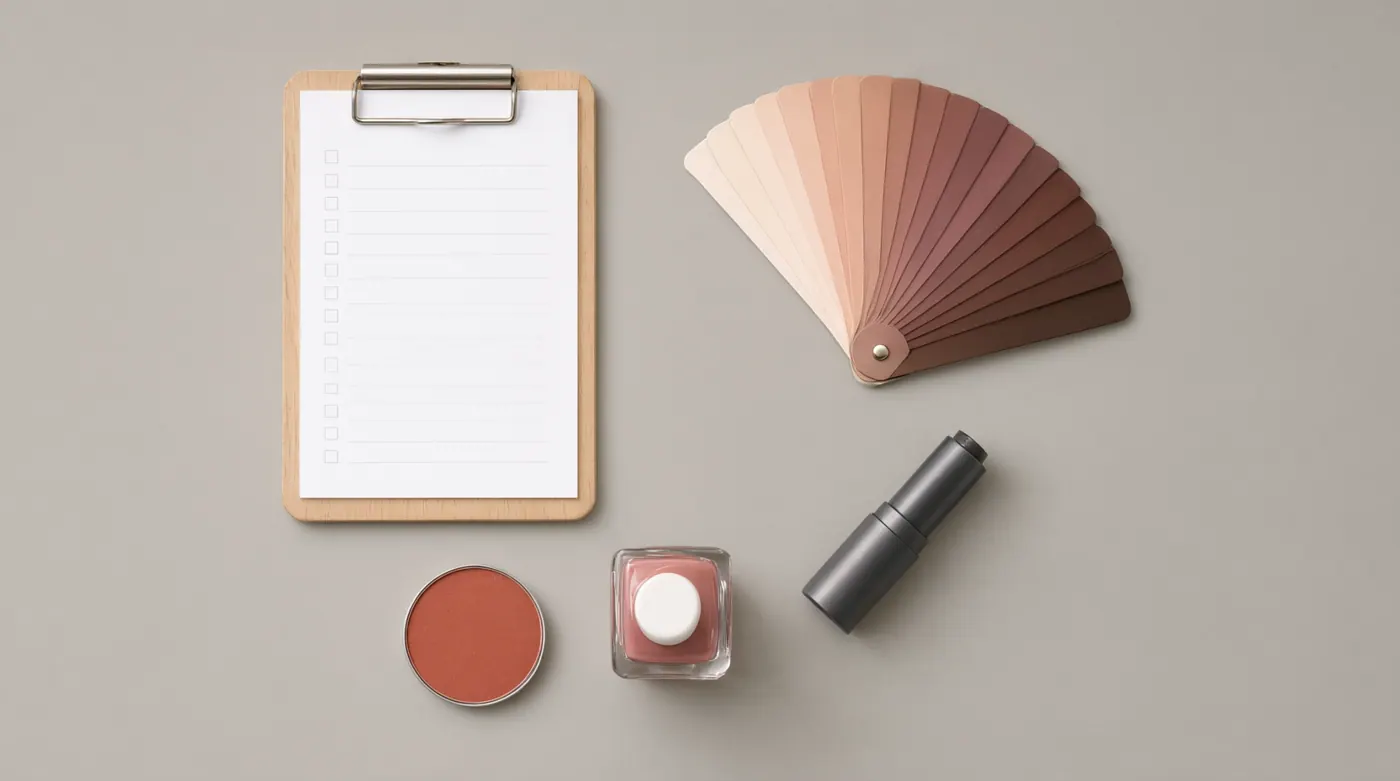
Choosing a contract cosmetic manufacturer in China is a filtering job, not a shopping job. Thousands of factories. Plenty of trading companies wearing a factory's clothes. A much smaller group that can take your sketch and hand back a retail-ready carton without drama. What follows is the checklist we would use from your side of the table. We don't sit there — we're a cosmetic factory in Jinhua — but hold us to every line of it anyway.
Print it. Take it into supplier calls. Write the answers down.
Factory or trading company? Settle it first
Ask for the business licence. Then ask for the production address. Check that the two match. Trading companies hand you an office in Yiwu or a sales suite in Guangzhou and go fuzzy when you ask which building the filling lines sit in. A real makeup manufacturer in China names the industrial zone, the workshop block, sometimes the line number. No hesitation.
Next, a live walk-through. Not the trade-show reel. Not drone footage from 2021. Ten minutes on a video call with the camera pointed at the powder press, the wax mill, the filling room, the finished-goods warehouse. Faking a running line at three on a Tuesday afternoon is harder than it sounds.
And what do they actually own? Powder pressing, wax milling, filling, assembly. Run all four in-house and you control quality and schedule both. Buy filling capacity from a neighbour and only assemble, and you're talking to a project manager. Nothing wrong with project managers. Price them accordingly.
Certificates: what each audit actually covers
Buyers send us a PDF full of logos and ask: are these good? Honest answer — each document answers a different question. A homepage can carry six badges and still tell you nothing. What matters is what sits under each one.
| Certificate | What it covers | What it does not cover |
|---|---|---|
| GMPC | Cosmetic Good Manufacturing Practice: premises, hygiene, equipment, documentation, batch traceability | Labour conditions, environment |
| ISO 22716 | The international GMP guideline for cosmetics. Different audit trail from GMPC, same ground | Social or ethical performance |
| BRCGS (BRC Global Standard for Cosmetics) | Product safety, quality and operational discipline. Retail buyers tend to weight this one most | Ethical trade |
| SMETA (Sedex) | Ethical trade audit: labour, health and safety, environment, business ethics | Product safety or GMP |
| BSCI (amfori) | Social compliance. Similar ground to SMETA, different scoring and follow-up | Product safety or GMP |
| RSPO | Sustainable palm oil, chain of custody for palm-derived ingredients | Anything outside palm sourcing |
Use the table this way. First, check the date and the scope. Does the audit cover the category you're buying and the line it will run on? Then ask for the report, not the badge. The non-conformities listed inside say far more about how a plant is run than the logo does. The standards behind them are public: ISO 22716, SMETA and amfori BSCI all publish theirs.
Magic Color holds GMPC, ISO 22716, BRCGS, SMETA, BSCI and RSPO, listed on our certifications page. None of that makes us the right fit for your project. It just means there's paper to pull apart.
QC checkpoints to raise before anyone mentions price
Quality control is where a cheap quote turns expensive. Slowly. Four checkpoints do most of the work:
- Incoming inspection. Raw materials and components get tested for physical and chemical properties, microbiology, heavy metals and phthalates. Plastic parts go further: separation force, tube print adhesion, label tack, compact opening force, salt-spray resistance, mirror glue strength, tube airtightness.
- First-article inspection. The first good unit off the line, signed off before the run continues.
- Patrol inspection. Someone walking the line on a schedule. Not on request.
- Finished-goods inspection. Physical and chemical checks come next, along with microbiology.
Here's the follow-up that separates a real system from a folder. What happens when a batch fails? Is there a deviation log, a rework decision, a signature? Where do retained samples live, and are they kept until six months after the end of the product's shelf life? If the answer is a cardboard box by the loading bay, you have your answer.
Probe the process, too. Sterile filling? It should hold to ±0.1 g at 18–26 °C and 45–65 %RH. Powders? Micronised past 2500 mesh and pressed under high pressure, so the pan doesn't crumble in transit. Lipsticks? Milled cold, emulsified at a constant temperature, cooled in stages to keep bubbles and hairline cracks out. A supplier who can't put numbers around their own process is describing someone else's. Ours is written up on the quality page — though making a supplier talk theirs through out loud beats reading ours.
Samples, test reports and the paper you should demand
Samples are the cheapest risk reduction you'll ever buy. Standard terms here: 3–7 days, free, you cover freight, two revisions at no cost. Formula development runs 14 days, or 7 on an express track that skips the full compatibility and stability panel up front.
With reports, be exact about what you're asking for. Every raw material should land with a COA. Finished goods should arrive with internal physical, chemical, microbial and heavy-metal testing — plus third-party reports from labs such as SGS, Intertek or CTI, available per batch on request. Ask for one from a batch you didn't pick. Then ask what the internal report shows that the third-party one doesn't. Usually it's the gap between a screening result and an accredited one.
Compliance is a separate stack of paper, and it's documentation, not decoration. Depending on where you sell, you'll want evidence for EU (EC) No 1223/2009 and REACH, EN-71 and CE for kids' items, FDA and MoCRA requirements in the US, GSO 1943/2021 for the Gulf, TR TC 009/2011 for Russia, India's Cosmetics Rules 2020, or the ASEAN Cosmetic Regulation. One warning worth repeating: the FDA runs a registration system, not an approval one. Nobody gets a badge from them for making lipstick. Any supplier who tells you otherwise is either confused or hoping you are.
Audits and factory visits that tell you something
Book the visit before you place the order. Not after the first shipment goes sideways. A day on site beats a month of email.
Bring your own list. Who signs the batch record? How long are records kept? Where are retained samples stored, and are they kept until six months after shelf life ends? What does the pest-control log say? How is process water treated? Does the cleanroom door have an interlock? Do staff move between powder and wax areas without changing gowns? Ask to see a batch record for something close to your product, then follow one lot number from raw material to carton. An hour of that teaches you more than three video calls.
Short notice is the real test. Anyone can stage a good day with three weeks' warning. You can arrange a visit through the factory page. Turn up with a week's notice rather than a month's and that's a better test of us, not a worse one.
Payment terms, MOQ and lead times
Market standard in China: 30% deposit, 70% before shipment, by T/T or L/C. Anything far off that — full prepayment, or 90 days open account from a supplier you've never audited — deserves a question. Terms do move with order history. They shouldn't move on a first order.
MOQ is where quotations get fuzzy. Basic models start at 6,000 pcs. Special processes — electroplating, 3D printing, silk-screen, embossing, custom moulds — sit at 12,000. Custom component shells follow the same 12,000. Sets run differently: 3,000 sets where standard processes apply to standard cases, sleeves, bags and gift boxes; 6,000 where special processes are involved. Price breaks usually land at 12k, 30k, 50k and 100k.
Lead times? 45 days standard from order confirmation to dispatch. Express runs take 30 days: a basic report comes first, the full report follows. Quotes typically hold for 30 days. Get every number in writing before you compare anything.
Blunt opinion: unit price matters less than failure rate. Three cents saved on a lipstick that arrives leaking, with a reorder you have to air-freight, isn't a saving. It's a rounding error with a customer-service bill stapled to it.
Capacity belongs in the same conversation. Ask how much of the stated capacity runs today and how much is a rendering. Here: 30+ automated lines, nearly 400 people across about 30,000 m², automation above 70%, 500+ mature formulas and over 600 new development samples a year. All filling workshops in the current Jinhua factory are Class 100,000 GMPC cleanrooms. A new facility of about 100,000 m² with 45 lines is planned to open in 2027. Worth knowing. Also worth labelling honestly — it's planned for 2027, not online now.
Red flags worth walking away from
- A logo pack with no scope pages and no audit dates.
- A fully custom formula quoted inside the hour. Real development takes 14 days.
- MOQ that stays "negotiable" until you ask for it in writing.
- No retained samples, or samples sitting somewhere without temperature control.
- A blank wall between you and the QC lead.
- Raw-material COAs handed over as finished-goods reports.
- Payment requested to a personal account instead of the company's.
- Claims that the FDA has approved the factory. It doesn't work that way, and no such badge exists in cosmetics.
Ten questions to paste into your RFQ
- Are you the manufacturer? Give the production address and the line I would run on.
- Which certificates do you hold? What's the scope? When was the last audit?
- Who signs off a batch? Can I see a batch record?
- Where do you keep retained samples — and are they held until six months after the end of the shelf life?
- What are your incoming, first-article, patrol and finished-goods checkpoints?
- Which third-party labs do you use, and can I have a report for a batch of my choosing?
- What is the MOQ for my pack, with and without special processes?
- What is the sampling timeline, and how many revisions are free?
- What are your deposit and balance terms? Which payment instruments do you accept?
- When can I visit? Will you take a short-notice visit?
Paste that list into three supplier conversations. The shortlist usually writes itself. The one who answers in detail, invites the awkward questions and puts numbers into the quotation is the one to sample with. If that turns out to be us, send a note about your project. Bring the checklist with you.
FAQ
How can I tell a real contract cosmetic manufacturer from a trading company?
Match the business licence address to the production address. Then ask for a live video walk-through of the powder press, filling room and warehouse. Trading companies give office addresses and get vague about which building the lines are in. A short-notice site visit settles it completely.
Which certificates should a cosmetic manufacturer in China hold?
For manufacturing practice, look for GMPC or ISO 22716. For retail supply chains, BRCGS carries weight. For ethical trade, SMETA or BSCI. RSPO matters only if you make palm-related claims. Always check the audit date, the scope and the non-conformities in the report. Don't trust the logo on the homepage.
What MOQ and lead times are normal?
Basic models often start around 6,000 pcs. Special processes and custom shells sit at 12,000 pcs. Sets start at 3,000 with standard processes and 6,000 with special processes. Production typically runs 45 days standard, or around 30 days on an express schedule. Quotations are commonly valid for 30 days.
What payment terms should I expect from a Chinese cosmetic factory?
The common structure is 30% deposit on contract signature and 70% before shipment, settled by T/T or L/C. Terms do vary with customer and order history. Full prepayment on a first order from an unaudited supplier is a warning sign worth questioning.