Buyer guide
Custom Eyeshadow Palette Guide: From Shade Brief to Pressed Pan
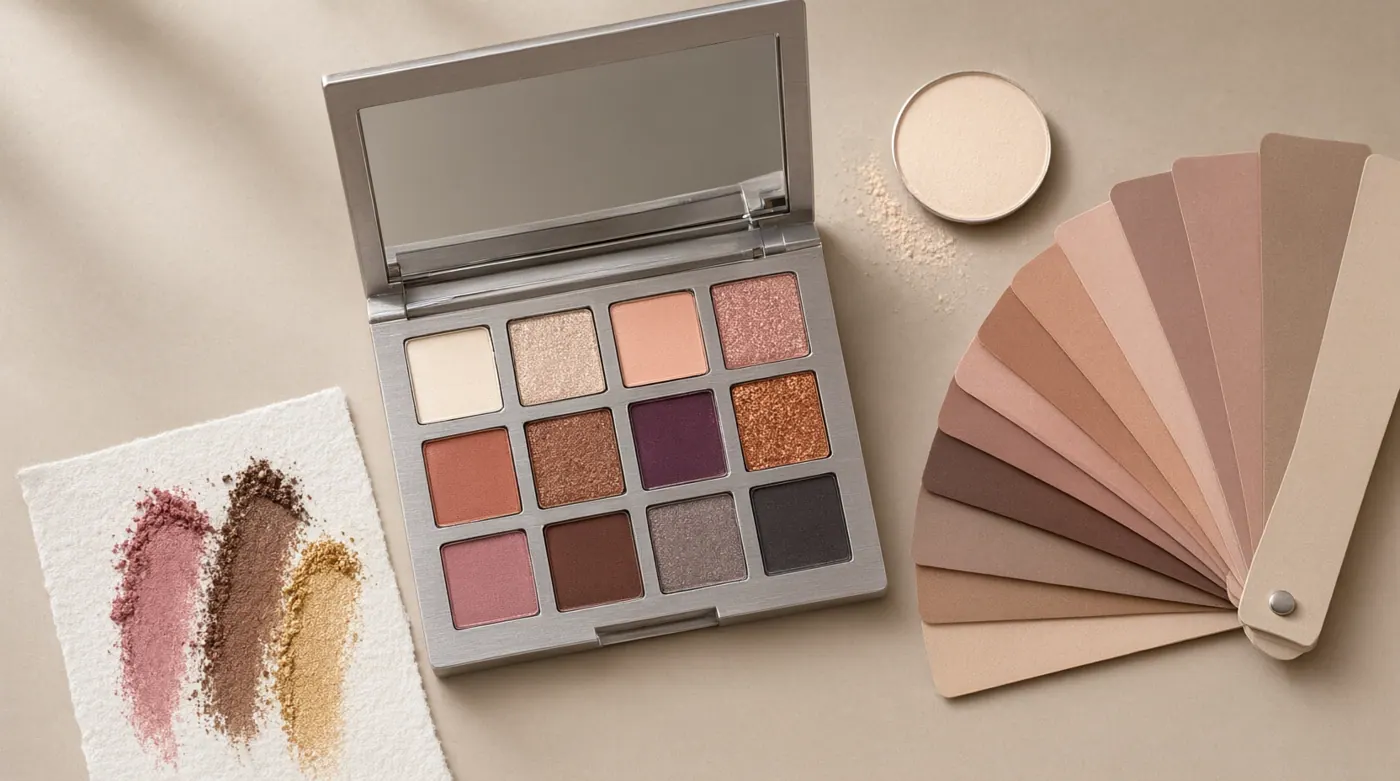
On a shelf, a custom eyeshadow palette looks simple: a case, a mirror, a row of pans. You approve a shade card, then the real work begins. Your brief has to travel through colourant screens, milling specs, pressing pressure, drop tests and a dozen small calls before a pressed pan reaches your warehouse. Those calls decide whether the launch reads premium or cheap. Here's the route, in the order it happens.
Your first palette or your fifth? The sequence barely moves. What shifts is how much you catch early. At Magic Color, we build custom eyeshadow palettes, with 500+ mature formulas in the library and over 600 new development samples a year. Most delays we see trace back to a brief that arrived half-finished. So start there.
Shade Brief First, Palette Second
A useful shade brief fits on one page. It is not a mood board. Give us the pan count, the finishes (matte, satin, shimmer, metallic, pressed glitter), the colour story in plain words, your retail price band, the market you'll sell in, and your launch date. If you have two or three physical references, add them — a competitor palette, a fabric swatch, a photo printed at actual size.
Then talk in colour numbers. Pantone gives you and your factory a shared language. "Dusty rose" never will. We match Pantone numbers to within ±2 ΔE and develop custom shades from scratch. Our shade card is refreshed every year. Screens lie, though. The same chip looks like a cousin, not a twin, under office lighting and under a store's warm spots. Approve against a physical standard. Never a JPEG.
One blunt note. Twelve shades that all read the same on the eyelid? That's the most common first-brief mistake. Build in a light transition shade, a deep matte for the outer corner, and a topper that does something the others can't. Your customer should be able to make three distinct looks without reaching for another palette.
Milling to 2500 Mesh, Then Pressing
Texture is won before the powder touches a pan. Our powder line mills to 2500 mesh and finer, using micronised milling, then presses at high pressure with a compliant binder system. Finer particles give you a smoother swatch, easier blending and less fallout. Fine powder is fussier, too — it needs the right binder level and the right press pressure, or it crumbles in the pan or turns hard and skips across the lid.
It's a balance, not a setting. Too much binder and your matte looks like vinyl on the eye. Too little and a palette that passed the lab shatters somewhere over the Atlantic. Finish changes the recipe, too. Mattes carry more filler and press dense. Shimmers need their pearl dispersed evenly, or you get stripes. Pressed glitters need a binder that holds the particle without welding the pan shut. "Mostly matte plus one duochrome" is genuinely useful. "Make it pop" means we send three directions and you lose a week choosing.
Talc-free builds, phthalate-free, formaldehyde-free and heavy-metal-controlled formulas all exist here. Tell us early. They're far easier to plan than to retrofit. Kids' ranges get extra attention, since EN-71 and CE requirements sit alongside the usual cosmetic rules.
Palette Formats and Materials
Format drives cost more than most buyers expect. A four-pan compact in PP is a different animal from a twelve-pan book with a full mirror in an aluminium alloy case. Housings come in PP, AS and ABS plastics, aluminium alloy (salt-spray tested) and paper options, including recycled board where the design allows. Mirrors, magnetic closures and refillable constructions are available. Brushes are synthetic fibre. Puffs are non-latex.
Small hardware makes a palette feel expensive in the hand: hinge tension, magnet strength, opening force, mirror adhesion, print durability. We check all of it on our side. Still, name your priority. Strong magnet? Soft-close hinge? A case that survives a tote bag for a year? Pick one thing the design must nail.
Decoration is where timelines quietly slip. Silk screen, hot stamping, UV and 3D printing each need artwork that respects bleed, minimum line weights and ink coverage on curved surfaces. Metal behaves differently from plastic. Approve a printed dummy. Not a PDF.
On volume: sets with standard processes start at 3,000 sets. Sets with special processes — electroplating, 3D printing, silk screen, embossing, custom moulds — start at 6,000 sets. The 3,000-set minimum applies to standard cases, sleeves, bags and gift boxes; there is no separate aluminium-case or paper-sleeve minimum any more. Custom component shells sit at 12,000. Price breaks land at 12k, 30k, 50k and 100k. If you're weighing a 9-pan against a 12-pan to hit a price point, have that argument during sampling, not after the artwork is signed.
Colourants, Annex IV, and Why CI Numbers Belong in the Brief
In the EU, cosmetic products must comply with Regulation (EC) No 1223/2009. Permitted colourants sit in Annex IV with conditions attached — some are restricted by product type or by the area of the body where they may be used, and some carry purity criteria. In practice, a pigment that's perfectly legal in a lip product may not be cleared for the eye area. The vivid end of your palette is exactly where this bites.
So bring colour index numbers into the brief early. We formulate for (EC) No 1223/2009 and for REACH, and colourants are matched against Annex IV as a matter of course. For the US, formulas are built to FDA and MoCRA requirements, and your artwork has to satisfy FDA labeling rules — ingredient declaration, net quantity, the works. Other markets run their own lists: GSO 1943/2021 in the Gulf, TR TC 009/2011 in Russia, plus UK, India and ASEAN regimes. Our compliance team tracks those differences so a formula cleared for one market doesn't get blocked in another.
Ask for the colourant documentation with your samples. Not because something is wrong — because your regulatory reviewer will want it before the label goes to print.
Transport Tests: The Dull Part That Saves Launches
Pressed powder is fragile. A palette that swatches beautifully and arrives with two cracked pans is a refund queue. Sample-stage testing here covers stability, compatibility, light exposure, drop and fit. During production we run simulated transport and drop tests alongside mirror adhesion, opening force, salt spray on metal parts, print adhesion and component fit.
Weight matters. A 12-pan alloy palette is heavier than a quad in plastic. The carton has to be specified for it: five-layer corrugated board, foam or bubble wrap, and a shipper that isn't asked to do more than it can. Palettes also move through hot containers and cold air-freight holds. That's why stability testing runs before the photography, not after it.
Sampling and Timeline, Planned Backwards
Standard formula development takes 14 days; express is 7, with the trade-off that compatibility and stability testing isn't included at that speed. Samples run 3–7 days, they're free, you cover the freight, and you get two free revisions before any cost kicks in. Bulk production is 45 days from order confirmation to dispatch, or 30 days on express with a priority slot and a full report to follow.
Now work backwards from launch. Sea freight to North America or Europe is 30–45 days. Air is 7–15. Express courier is 3–7. Add buffer for artwork, barcodes and your own retail sign-off. A palette that misses its window usually missed it at the brief, not at the port.
When samples land, test them like a customer. Swatch on bare skin and on primer. Wear one shade for a whole day. Blend with the brush you plan to ship. Photograph the palette under the lighting your retailer uses. Then drop it from waist height onto a hard floor. Twice. Watch what happens. That last test tells you more than any spec sheet.
Quality Checks Between Press and Carton
Every raw material arrives with a COA. We test it for physical, chemical, microbial and heavy-metal parameters. Powders go through first-article inspection, then patrol and finished-goods checks. Batch samples are retained in a constant-temperature, constant-humidity room until six months after the end of the product's shelf life. Third-party reports from SGS, Intertek or CTI are available per batch on request. If you're building eyeshadow only or a whole eye category, our eye makeup range shows the formats we run.
What to Send Us First
- Pan count, finishes and a plain-language colour story
- Pantone references or physical swatches
- Target market, retail price band and launch date
- Packaging direction and any material must-haves
- Compliance notes: talc-free, fragrance-free, kids' range, EU or US first
- Estimated first-order quantity — we quote against real price breaks
That's enough to start. Send it to our team. You'll get a quotation, valid 30 days, plus a sampling plan. If you want to see the press room before you commit, book a factory visit — we're in Jinhua, near Ningbo and Shanghai. The OEM/ODM process page explains how orders move from brief to shipping. A new facility of about 100,000 m² with 45 lines is due to open in 2027; it is planned to add eyeshadow capacity of 2.3 million boxes a month. Today's Jinhua plant runs 30+ automated lines at over 70% automation, and all filling workshops in the current Jinhua factory are Class 100,000 GMPC cleanrooms.
FAQ
How long does a custom eyeshadow palette take from brief to delivery?
Formula development takes 14 days. Express is 7 days, but that speed leaves out compatibility and stability testing. Samples take 3–7 days. Bulk production is 45 days from order confirmation to dispatch, or 30 days on express. Then add shipping: sea 30–45 days, air 7–15, courier 3–7.
What is the minimum order quantity for a custom eyeshadow palette?
Sets with standard processes start at 3,000 sets. Sets with special processes — electroplating, 3D printing, silk screen, embossing or a custom mould — start at 6,000 sets. The 3,000-set minimum applies to standard cases, sleeves, bags and gift boxes; there's no separate aluminium-case or paper-sleeve minimum. Custom component shells are 12,000. Price breaks kick in at 12k, 30k, 50k and 100k.
Can you match a specific Pantone shade?
Yes. We match Pantone numbers to within ±2 ΔE and develop custom shades beyond the shade card, which is updated each year. Approve against a physical chip or swatch, not a screen. Expect small variation between batches — that's normal for pigments. It's why we press a standard for you to keep.
Which colourants can be used in the eye area?
In the EU, permitted colourants are listed in Annex IV of Regulation (EC) No 1223/2009. Restrictions apply by product type or application area, and some carry purity criteria. We screen colour index numbers against Annex IV and REACH early, and build US formulas to FDA and MoCRA requirements. Flag your hero shades in the brief so restrictions surface before sampling, not after.